Teachers speak in public more than almost anyone else. Every lesson is a talk to an audience that did not choose to be there, and the same teacher may present to colleagues at a staff meeting on Tuesday and to a room of parents on Thursday. Yet very few teachers were ever trained to use their voice, manage nerves or structure a talk.
Here are practical public speaking tips for teachers, built for the classroom rather than the boardroom: voice, pauses, posture, nerves, questions, and how to open and close a lesson or a presentation. Research sources are listed at the end.
What are the most important public speaking tips for teachers?
The most important public speaking tips for teachers are to protect your voice instead of raising it, to use pauses deliberately, and to plan how you open and close every lesson or talk. Add calm, open body language and a simple routine for handling nerves, and you will hold the room more easily with less effort. All of these are skills, so they improve with practice and feedback.
How can teachers protect their voice?
Your voice is your main working tool, and it is more fragile than it seems. In a large study of 2,531 people in two US states, 57.7% of teachers reported a voice disorder at some point in their lives, compared with 28.8% of non-teachers; 11.0% of teachers had a voice problem at the time of the interview, against 6.2% of non-teachers. The authors concluded that teaching is a high-risk occupation for voice disorders.
Practical ways to save your voice in class:
- Stop talking over noise. Agree on a non-verbal signal for silence (a raised hand, a countdown on the board, a sound) and wait for it to work instead of raising your volume.
- Move closer instead of speaking louder. Walking towards a group is often more effective than projecting across the room.
- Share the talking. Pair work, group tasks and student explanations reduce the minutes you speak and increase the minutes students think. Our article on cooperative learning has ideas for structuring this.
- Consider amplification if you teach in large or noisy spaces. In a small randomised trial with 44 teachers who already had voice problems, both a portable voice amplifier and vocal hygiene instruction led to more improvement on some measures than no treatment, and the teachers who used amplification reported greater ease of voice production.
A hoarse voice that does not go away is not something to push through: ask a doctor or a speech-language therapist for advice.
How do pauses help you hold the room?
Silence is one of the strongest tools a speaker has, and teachers tend to use too little of it. In her classic review of research on questioning, Mary Budd Rowe noted that when teachers ask students a question, they typically wait less than one second for a response, and after a student stops speaking they react or ask another question in less than one second. Her review distinguishes two pauses: wait time 1, after you ask a question, and wait time 2, after a student answers, and it examines how teachers can be trained to lengthen both.
How to use pauses in practice:
- Pause after a question and resist the urge to rephrase it or answer it yourself. Count silently if it helps.
- Pause after an answer before you evaluate it. Other students often add something, and the first student may complete their own thought.
- Pause before a key point. A short silence signals “this matters” better than a louder voice.
- Pause to regain attention. Stopping mid-sentence when the room gets noisy is often quicker than talking over it.
Slowing down can also help listeners who are following you in a second language, a situation that is common in multilingual classrooms and in international meetings.
How should teachers stand and move in front of a class?
Body language tells students whether you are confident, relaxed and interested in them before you say a word. You do not need a script for every gesture, but a few habits make a visible difference:
- Find a home position. Choose a spot where everyone can see you and return there when you give instructions or explain something important. Students learn to read it as “listen now”.
- Stand steady, then move with purpose. Walk to a group to check their work or to bring someone back into the lesson, rather than pacing while you talk.
- Keep your hands visible and open. Use them to point at the board, count steps or show size, not to hold your phone or fiddle with a pen.
- Make eye contact with the whole room. Teachers often look mostly at the students who answer. Move your gaze to the back corners and the quiet rows too.
How can teachers manage nerves before speaking?
Even experienced teachers feel nervous before an inspection, an open lesson, a presentation to colleagues or a parents’ evening. The usual advice is “calm down”, but research suggests another option. In a series of experiments that included public speaking tasks, Alison Wood Brooks found that people who reappraised their anxiety as excitement felt more excited and performed better than people who tried to calm down. Simple self-talk, such as saying “I am excited” out loud, was enough to shift their mindset from threat to opportunity.
A short routine before you speak:
- Name the feeling as energy: “I’m excited about this”, not “I must not be nervous”.
- Breathe out slowly a few times to settle your voice.
- Rehearse your first two sentences until they feel natural.
- Arrive early and check the room and the technology.
How do you open and close a lesson or a presentation?
The first minute sets the tone, and the last minute is what people take with them, so plan both as carefully as the content.
Strong openings, in class or with adults:
- a question that the lesson or talk will answer;
- a short story, image or problem from real life;
- a clear map: “Today we will do three things”.
Avoid opening with apologies (“I’m not very good at this”) or with technical problems; set up the room beforehand.
Strong closings:
- summarise the key message in one or two sentences;
- ask students or participants to say what they will remember or do next;
- end on time, with a clear next step.
The same structure works when you present to colleagues or speak to parents. With parents in particular, keep the message short, concrete and positive, invite questions, and follow up in writing; our guide to parent-teacher communication covers this in more detail.
How should teachers handle questions from the audience?
Questions are where many speakers lose the room, and where good teachers win it back. A few habits help:
- Repeat or rephrase the question so that everyone hears it and you gain a few seconds to think.
- Answer briefly, then check: “Does that answer your question?”
- It is fine not to know. “Good question, I will check and come back to you” builds more trust than an improvised answer.
- Manage dominant voices politely: “Let’s hear from someone who hasn’t spoken yet.”
How can teachers improve their public speaking over time?
Public speaking is a skill, and skills grow with deliberate practice and feedback:
- Record yourself teaching for ten minutes and watch it once with the sound off (body language) and once without the image (voice and pauses).
- Ask a colleague to observe one specific thing, such as how long you wait after questions.
- Work on the relationship, not only the performance. A class that trusts you is easier to speak to; see our article on the teacher-student relationship.
- Take a course where you can rehearse in a safe group and get personal feedback.
From our experience at ELA
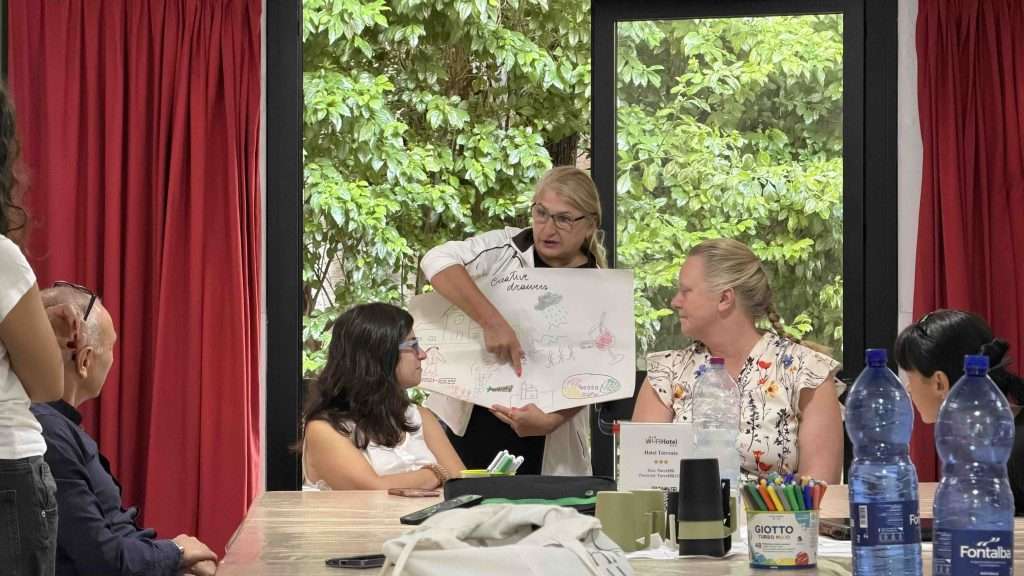
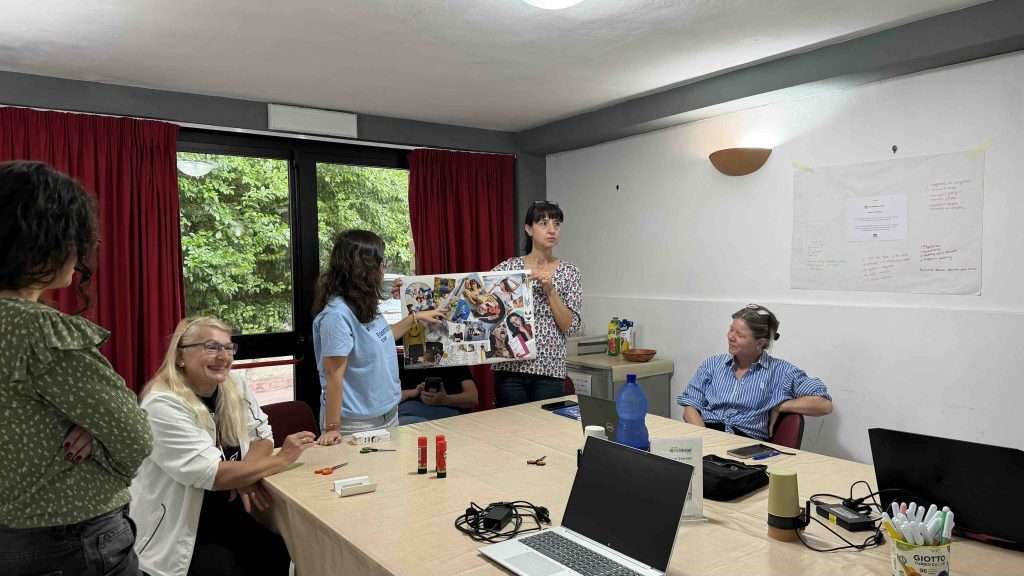
Most teachers who join our Effective Communication and Public Speaking for teachers and education staff course are not looking for theory: they want to practise. The course is hands-on: participants plan, structure and deliver their own speeches and presentations in a small, supportive group, work on audience engagement, body language and assertive communication, and receive personal feedback based on their professional role. One participant from a session in Palermo wrote: “I left Palermo with improved communication skills, a broadened network, and lasting memories.” (Ulvi Renser, Estonia). If you want to work on a wider set of skills, such as teamwork, conflict management and emotional intelligence, look at Soft Skills and Emotional Intelligence for teachers and education staff, or browse all Erasmus+ classroom management and soft skills courses.
Sources
- Roy N., Merrill R. M., Thibeault S., Parsa R. A., Gray S. D., Smith E. M., Prevalence of voice disorders in teachers and the general population, Journal of Speech, Language, and Hearing Research, 47(2), 281-293, 2004.
- Roy N. et al., Voice amplification versus vocal hygiene instruction for teachers with voice disorders: a treatment outcomes study, Journal of Speech, Language, and Hearing Research, 45(4), 625-638, 2002.
- Rowe M. B., Wait time: slowing down may be a way of speeding up!, Journal of Teacher Education, 37(1), 43-50, 1986.
- Brooks A. W., Get excited: reappraising pre-performance anxiety as excitement, Journal of Experimental Psychology: General, 143(3), 1144-1158, 2014.
P.S. Want to practise these skills with colleagues from across Europe, funded by Erasmus+? Download our course catalogue to see all communication and soft skills courses.
 English (UK)
 Español
 Italiano
 Deutsch
 Română
 Български
 Čeština
 Ελληνικά
 Polski
 Português
 Français