In an era dominated by screens, structured schedules, and indoor classrooms, a growing number of educators are rediscovering the transformative power of learning beyond the four walls of traditional schools. Outdoor education transforming learning through nature has emerged as one of the most impactful pedagogical approaches of the 21st century, reconnecting students with nature while fostering skills that are difficult to cultivate through conventional teaching methods.
For teachers, school leaders, and educational professionals, understanding outdoor education is no longer optional. It represents a paradigm shift that aligns with contemporary priorities: environmental sustainability, mental well-being, experiential learning, and social competences. This complete guide explains what outdoor education is, its objectives, benefits, and practical applications from kindergarten to higher grades, offering concrete ideas for implementation.
Outdoor education: what is it?
Outdoor education is an experiential learning approach that takes place primarily in natural or outdoor environments, using the surroundings as both a classroom and a teaching tool. It integrates cognitive, physical, emotional, and social learning through direct contact with nature, hands-on activities, and real-world experiences.
Unlike simply moving traditional lessons outside, outdoor education is built on specific pedagogical principles:
- learning by doing;
- place-based education;
- environmental awareness,
- holistic development.
It draws from the traditions of Montessori, Steiner, Dewey’s experiential learning, and the Scandinavian friluftsliv philosophy, which values open-air life as essential to human growth.
In practice, outdoor education can take many forms: forest schools, garden-based learning, adventure education, nature walks, outdoor science experiments, or full immersion programs in natural settings. What unites these approaches is the belief that the environment itself is a teacher.
What is the outdoor method of teaching and learning?
The outdoor method of teaching and learning is a pedagogical approach that uses outdoor spaces as active learning environments, where students engage with real materials, phenomena, and challenges. It combines observation, exploration, problem-solving, and reflection to build knowledge in a meaningful way.
This method is characterized by:
- direct experience (students learn by touching, observing, and manipulating real objects and natural elements);
- interdisciplinarity (a single outdoor activity may cover science, math, art, and language simultaneously);
- student autonomy (learners are encouraged to make decisions, take risks (calibrated risks), and lead their own inquiries);
- teacher as facilitator (the educator guides rather than instructs, prompting curiosity and reflection).
The outdoor method is deeply rooted in constructivist theory, where knowledge is built through active engagement with the environment rather than passively received. Many practitioners emphasize the principle of learning-by-doing as central to successful outdoor pedagogy.
Environmental education objectives
Outdoor education and environmental education are closely intertwined. While outdoor education focuses on the how (learning in nature), environmental education focuses on the what (learning about nature and sustainability). Together, they pursue the following objectives:
- awareness: helping students recognize environmental issues and their global impact;
- knowledge: providing a deep understanding of ecosystems, biodiversity, and human-nature interactions;
- attitudes: cultivating respect, empathy, and responsibility toward the planet;
- skills: developing the ability to identify environmental problems and propose solutions;
- participation: encouraging active involvement in protecting and preserving the environment.
These objectives, originally outlined in the Tbilisi Declaration (1977) and reaffirmed by UNESCO, remain the foundation of contemporary environmental and sustainability education across Europe and beyond. Practical school-level work often includes implementing green practices and bringing environmental awareness to the classroom to move from awareness to action.
Outdoor education in kindergarten
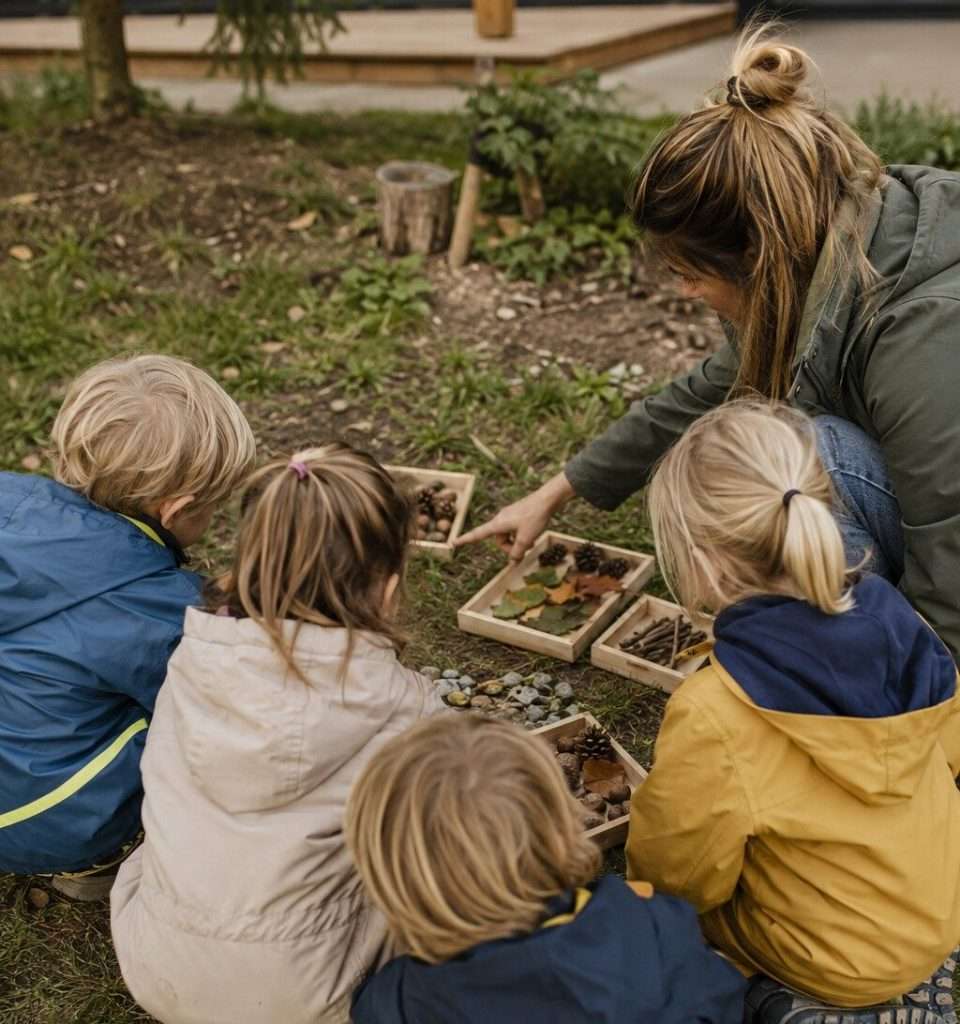
Outdoor education in kindergarten is particularly powerful because early childhood is a critical period for sensory development, motor skills, and emotional regulation. Young children are naturally curious about their surroundings, and outdoor environments provide endless opportunities for discovery.
In kindergarten settings, outdoor education typically includes:
- nature exploration (collecting leaves, observing insects, listening to birds);
- sensory play (with mud, water, sand, stones, and plants);
- free movement (climbing, running, balancing on natural surfaces);
- storytelling and imagination (using natural elements as props for role-play);
- gardening (planting seeds, watering, and harvesting simple crops).
The Scandinavian model of forest kindergartens (where children spend most of the day outdoors, regardless of weather) has inspired many programs across Europe. Research consistently shows that children in outdoor kindergartens develop stronger motor skills, better concentration, higher creativity, and greater emotional resilience.
What are the key elements of an outdoor classroom?
An outdoor classroom is a designed space that supports structured and unstructured learning in nature. It is not simply a patch of grass but an intentional environment. The key elements of a successful outdoor classroom include:
- defined learning zones: areas for group discussion, quiet reflection, hands-on experiments, and physical activity;
- natural seating and surfaces: logs, stones, tree stumps, or wooden benches;
- access to natural materials: soil, water, plants, and loose parts children can manipulate;
- weather protection: shaded areas, canopies, or shelters for use in all seasons;
- storage for tools and supplies: waterproof containers for magnifying glasses, notebooks, gardening tools;
- safety considerations: clear boundaries, first aid access, and age-appropriate risk assessment;
- integration with the curriculum: the space must support specific learning objectives across subjects.
- A well-designed outdoor classroom becomes an extension of the indoor learning environment, not a replacement. Practical guidance on bringing the outdoors into the classroom can help schools design effective spaces.
Outdoor Education Ideas for Teachers
Bringing outdoor education into daily practice does not require a forest or a large budget. Here are practical outdoor education ideas that can be adapted to different age groups and contexts:
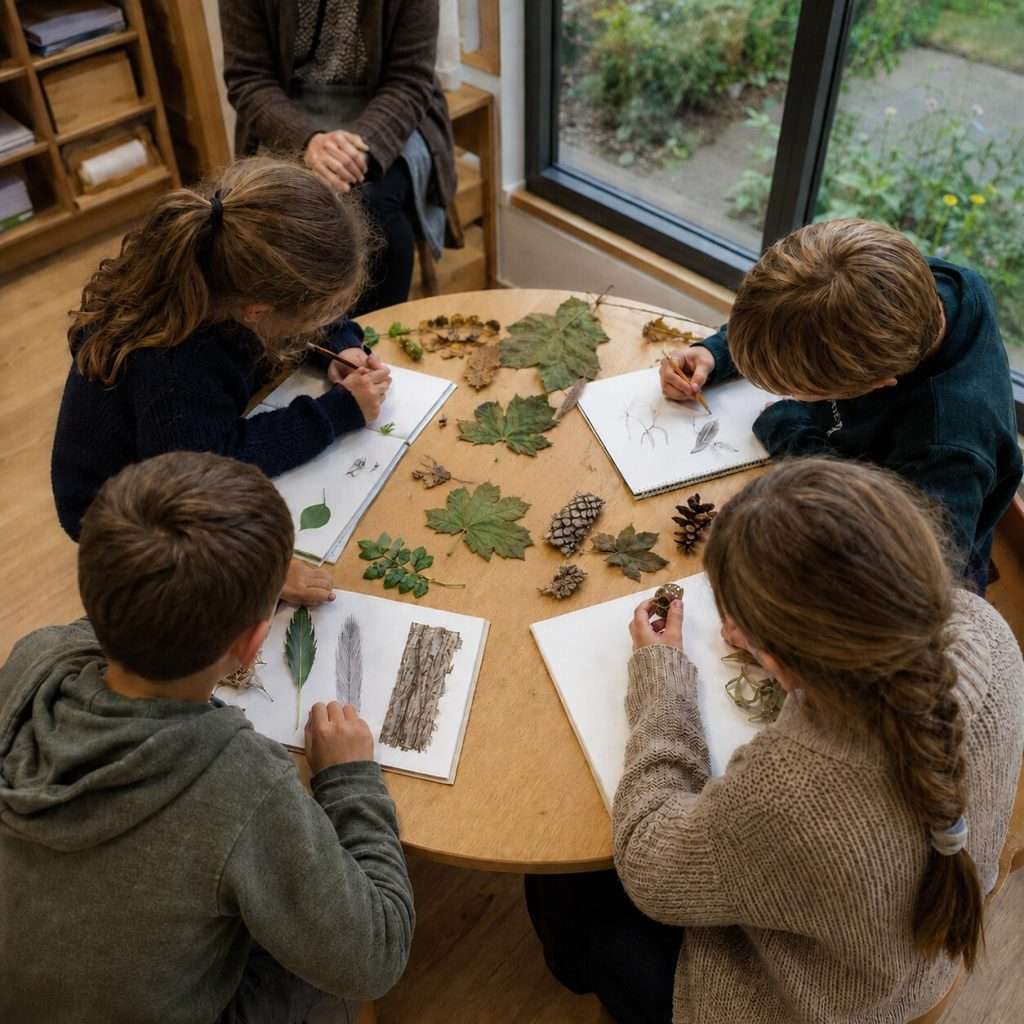
- nature journals (students record observations, sketches, and reflections during regular outdoor sessions);
- Math in nature (measuring trees, counting leaves, exploring symmetry in flowers, or calculating shadows);
- outdoor storytelling circles (reading and creating stories inspired by the environment);
- weather stations (building simple instruments to measure rainfall, temperature, and wind);
- bug hotels and bird feeders (hands-on biology and ecology projects);
- orienteering and map-making (geography and problem-solving in real space);
- outdoor art (land art inspired by Andy Goldsworthy, using only natural materials);
- historical walks (exploring local heritage sites as living history lessons);
- sustainability challenges (waste audits, recycling projects, or planting native species).
These activities can be integrated into any subject area, making outdoor education a versatile tool rather than an isolated practice.
What are outdoor education benefits?
The benefits of outdoor education are supported by an extensive body of research and observation. They span multiple dimensions of student development:
- Cognitive benefits
– Improved concentration and attention span
– Enhanced problem-solving and critical thinking
– Better academic performance across subjects
– Increased creativity and curiosity - Physical benefits
– Greater physical activity and motor skill development
– Reduced risk of obesity and related health issues
– Strengthened immune system through exposure to diverse environments
– Better vision (linked to natural light exposure) - Emotional and social benefits
– Reduced stress, anxiety, and symptoms of ADHD
– Increased self-confidence and resilience
– Stronger social bonds and cooperation skills
– Greater sense of belonging and connection - Environmental benefits
– Deeper ecological awareness
– Sense of responsibility toward the planet
– Long-term pro-environmental behaviors
For teachers, outdoor education also offers professional benefits: renewed motivation, stronger relationships with students, and a more meaningful teaching practice.
A path forward for educators
Outdoor education is far more than a trend; it is a research-backed, holistic approach that responds to the challenges of modern schooling. By stepping outside the traditional classroom, teachers open up possibilities for deeper learning, healthier students, and a more sustainable future.
Whether starting with small nature walks or designing a full outdoor curriculum, every step taken outdoors is a step toward richer, more human education. For practical frameworks on integrating outdoor learning into formal education, schools can adopt scalable strategies to make outdoor learning routine rather than occasional.
 English (UK)
 Español
 Italiano
 Deutsch
 Română
 Български
 Čeština
 Ελληνικά
 Polski
 Português
 Français